

























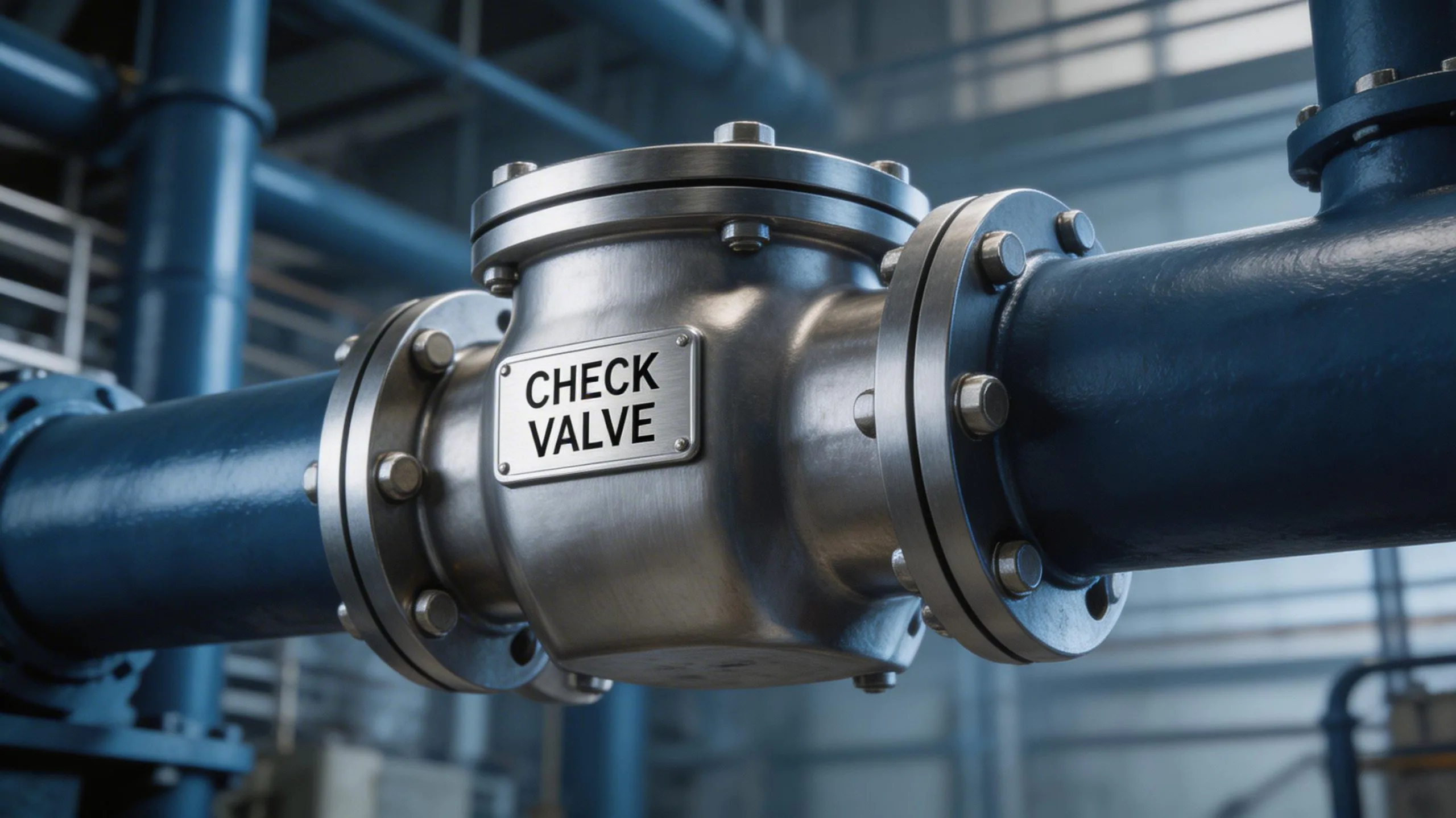
With over 17 years of engineering excellence and German technology heritage, COVNA GROUP CO., LTD has established itself as a world-leading valve manufacturer. Our ISO 9001, CE, and RoHS certified facilities have served 5,000+ industrial applications across water treatment, oil & gas, chemical processing, and power generation sectors. This comprehensive guide draws from our extensive experience to explain everything you need to know about check valves, from fundamental working principles to advanced selection criteria.
What is a Check Valve?
A check valve (also known as a non-return valve or one-way valve) is a mechanical device designed to allow fluid flow in one direction only. Unlike other valve types that require manual operation or external actuation, check valves operate automatically based on pressure differential. When upstream pressure exceeds downstream pressure, the valve opens to permit flow. When the pressure equalizes or reverses, the valve closes to prevent backflow.
The fundamental purpose of check valves is to protect equipment and systems from damage caused by reverse flow. This protection is critical in applications ranging from simple water pumping systems to complex petrochemical processing plants. COVNA's check valve portfolio includes swing check, lift check, dual plate, and ball check configurations, each optimized for specific operating conditions.
How Check Valves Work
Check valves operate on a simple yet elegant principle: differential pressure. Here's the step-by-step working mechanism:
- Forward Flow Condition: When fluid pressure on the inlet side exceeds the outlet pressure by a predetermined amount (cracking pressure), the valve disc or plate lifts off its seat, creating an open flow path.
- Flow Maintenance: As long as the pressure differential maintains sufficient force, the valve remains open, allowing unrestricted flow with minimal pressure drop.
- Closing Action: When flow stops or reverses, gravity, spring force, or back pressure causes the disc to return to its seat, sealing the valve closed.
- Backflow Prevention: The sealed position prevents any reverse flow, protecting upstream equipment from damage.
The cracking pressure, the minimum pressure required to open the valve, varies by design. Swing check valves typically require 0.5-1.0 psi, while spring-loaded designs may need 5-25 psi depending on spring rating.
Types of Check Valves
COVNA manufactures four primary check valve types, each engineered for specific applications and operating conditions:
1. Swing Check Valve
The swing check valve has a disc mounted on a hinge or trunnion that swings open during forward flow and closes by gravity when flow stops. This design offers:
- Low pressure drop when fully open
- Suitable for horizontal and vertical (upward flow) installations
- Sizes ranging from 2" to 48" (DN50 to DN1200)
- Pressure ratings up to Class 2500 (PN420)
Swing check valves excel in water and wastewater applications, large-diameter pipelines, and systems with minimal pulsation. COVNA's swing check valves meet API 6D and ASME B16.34 standards.
2. Lift Check Valve
Lift check valves feature a disc that moves vertically along the valve body centerline. The disc lifts off the seat during forward flow and returns by gravity or spring force when flow reverses. Key characteristics include:
- Compact design suitable for high-pressure applications
- Faster closing response than swing check valves
- Available in horizontal and vertical (upward flow) configurations
- Spring-loaded options for vertical downward flow
Lift check valves are ideal for high-pressure steam systems, boiler feedwater lines, and applications requiring rapid closure to prevent water hammer.
3. Dual Plate Check Valve
The dual plate check valve (also called double door or split disc check valve) uses two spring-loaded half-moon shaped discs that fold together during flow and close via spring force when flow stops. Advantages include:
- Compact, wafer-style design reduces weight by 70% compared to swing check valves
- Spring-assisted closure prevents water hammer
- Low cracking pressure (typically 1-5 psi)
- Suitable for HVAC, water treatment, and process industries
COVNA's dual plate check valves feature ASTM A216 WCB carbon steel or ASTM A351 CF8M stainless steel bodies with EPDM, NBR, or Viton sealing options.
4. Ball Check Valve
Ball check valves use a spherical ball as the closing element. The ball lifts off its seat during forward flow and seals against a conical or spherical seat when flow reverses. Features include:
- Simple, maintenance-free design
- Excellent for viscous fluids and slurries
- Self-cleaning action as ball rotates during operation
- Available in PVC, brass, and stainless steel constructions
Ball check valves are commonly used in wastewater treatment, chemical dosing systems, and applications handling suspended solids.
Check Valve Type Comparison
| Type | Design | Pressure Rating | Size Range | Best Applications |
|---|---|---|---|---|
| Swing Check | Hinged disc | Up to Class 2500 | 2" - 48" | Water, wastewater, large pipelines |
| Lift Check | Vertical disc | Up to Class 4500 | 0.5" - 24" | Steam, high-pressure systems |
| Dual Plate | Spring-loaded dual discs | Up to Class 900 | 2" - 36" | HVAC, water treatment, process |
| Ball Check | Spherical ball | Up to Class 600 | 0.25" - 12" | Viscous fluids, slurries, wastewater |
Material Selection Guide
| Material | ASTM Grade | Applications | Temperature Range | Corrosion Resistance |
|---|---|---|---|---|
| Carbon Steel | A216 WCB | Water, steam, oil | -29°C to 425°C | Low (requires coating) |
| Stainless Steel 304 | A351 CF8 | Food, chemical, general | -196°C to 540°C | Good |
| Stainless Steel 316 | A351 CF8M | Marine, chemical, pharma | -196°C to 540°C | Excellent |
| Cast Iron | A126 B | Water, HVAC | -29°C to 232°C | Low |
| Bronze | B62 | Seawater, marine | -29°C to 260°C | Excellent |
| Alloy 20 | A351 CN7M | Sulfuric acid, chemicals | -196°C to 316°C | Superior |
Check Valve Applications by Industry
Water and Wastewater Treatment
Check valves in water treatment systems prevent backflow that could contaminate clean water supplies. COVNA's resilient seated swing check valves and dual plate designs are widely specified for:
- Pump discharge lines
- Filter backwash prevention
- Chemical dosing systems
- Sludge handling lines
Oil and Gas
In petroleum refining and pipeline transport, check valves protect compressors and pumps from damaging reverse flow. COVNA supplies API 6D certified check valves for:
- Pipeline isolation
- Compressor protection
- Storage tank fill lines
- Refinery process units
Chemical Processing
Chemical plants require check valves with superior corrosion resistance. COVNA's stainless steel and alloy check valves handle:
- Acid transfer lines
- Caustic soda systems
- Solvent handling
- Reactor feed lines
Power Generation
Power plants rely on check valves for boiler feedwater, condensate, and cooling water systems. COVNA's high-pressure lift check valves meet ASME Section I requirements for:
- Boiler feed pumps
- Steam systems
- Condensate return
- Turbine protection
HVAC Systems
Heating, ventilation, and air conditioning systems use compact dual plate check valves for:
- Chiller isolation
- Boiler protection
- Circulating pump systems
- Cooling tower lines
Industry Application Matrix
| Industry | Recommended Type | Preferred Material | Key Standards |
|---|---|---|---|
| Water Treatment | Swing, Dual Plate | Cast Iron, Ductile Iron | AWWA C508, API 6D |
| Oil & Gas | Swing, Piston | Carbon Steel, SS316 | API 6D, API 594 |
| Chemical | Ball, Lift | SS316, Alloy 20 | ASME B16.34, API 602 |
| Power Generation | Lift, Swing | Carbon Steel, WC6 | ASME Section I, API 600 |
| HVAC | Dual Plate | Bronze, Cast Iron | ASME B16.1, MSS SP-125 |
| Marine | Swing, Lift | Bronze, SS316 | API 6D, MIL-V-20042 |
Check Valve Selection Guide
Selecting the right check valve requires careful consideration of system parameters. COVNA's engineering team recommends evaluating these factors:
1. Line Size and Flow Rate
Match valve size to pipe diameter for optimal performance. Oversizing causes disc flutter; undersizing creates excessive pressure drop. COVNA provides sizing calculations based on:
- Flow rate (GPM or m³/h)
- Fluid velocity (ft/s or m/s)
- Acceptable pressure drop
2. Pressure and Temperature
Verify valve pressure rating exceeds maximum system pressure with appropriate safety margin. Temperature affects material selection and sealing performance.
3. Fluid Characteristics
Consider fluid properties when selecting materials and valve type:
- Corrosivity: Determines body and trim material requirements
- Viscosity: High-viscosity fluids may require ball check valves
- Suspended solids: Slurries need full-port designs with self-cleaning features
- Multi-phase flow: Consider water hammer potential in liquid-gas mixtures
4. Installation Orientation
Check valve performance depends on proper orientation:
- Horizontal lines: Most check valve types suitable
- Vertical up flow: Swing, lift, and dual plate valves work well
- Vertical down flow: Requires spring-loaded lift or dual plate designs
Installation Best Practices
Proper installation ensures optimal check valve performance and longevity. COVNA recommends these practices based on thousands of field installations:
- Orientation: Install according to flow direction arrow marked on valve body
- Support: Provide adequate pipe support, especially for large swing check valves
- Clearance: Ensure sufficient clearance for disc movement and maintenance access
- Strainers: Install upstream strainers to prevent debris from damaging valve seats
- Testing: Perform hydrostatic testing per API 598 or ASME B16.34 requirements
Common Issues and Troubleshooting
| Problem | Possible Causes | Solutions |
|---|---|---|
| Water hammer | Fast-closing valve, high flow velocity | Use dual plate with spring, add surge tank |
| Disc flutter | Oversized valve, turbulent flow | Resize valve, add straight pipe upstream |
| Leakage | Worn seat, debris, corrosion | Clean or replace seat, inspect materials |
| Excessive pressure drop | Undersized valve, partially open | Resize valve, check minimum flow |
| Failure to close | Debris, damaged hinge, wrong orientation | Clean valve, inspect components, check installation |
| Noise/vibration | Cavitation, disc flutter, loose components | Check flow conditions, tighten fasteners |
Maintenance Guidelines
Regular maintenance extends check valve service life and prevents costly system failures. COVNA recommends this maintenance schedule:
- Monthly: Visual inspection for leaks, unusual noise, or vibration
- Quarterly: Exercise valve by briefly reversing flow (if system allows)
- Annually: Internal inspection of disc, seat, and hinge components
- 5-year intervals: Complete disassembly, component replacement as needed
Standards and Certifications
COVNA check valves are manufactured to international standards ensuring quality and interchangeability:
- API 6D: Pipeline valves (swing and dual plate check valves)
- API 594: Check valves (compact steel design requirements)
- ASME B16.34: Valves, flanged, threaded, and welding end
- ASME Section I: Power boiler requirements
- ISO 14313: Petroleum and natural gas industries, pipeline transportation systems
- ISO 9001: Quality management systems
- CE/PED: Pressure Equipment Directive compliance
"COVNA's commitment to German engineering standards and 17 years of manufacturing excellence ensures every check valve delivers reliable performance in the most demanding industrial applications. Our 5,000+ application database informs continuous product improvement."
, COVNA Engineering Team
Frequently Asked Questions
What is the difference between swing check and lift check valves?
Swing check valves use a hinged disc that rotates open and closed, suitable for large-diameter, low-pressure applications. Lift check valves use a vertically moving disc, offering faster closure and better performance in high-pressure systems. Swing check valves have lower pressure drop when open; lift check valves respond more quickly to flow reversal.Can check valves be installed vertically?
Yes, but orientation matters. Swing check valves work in vertical pipes with upward flow. Lift check valves function in vertical up flow and can handle downward flow with spring assistance. Dual plate check valves work in any orientation due to spring-loaded closure. Always verify manufacturer specifications for your specific valve model.How do I prevent water hammer with check valves?
Water hammer occurs when check valves close rapidly, causing pressure spikes. Prevention methods include: using dual plate check valves with controlled spring closure, installing surge tanks or accumulators, adding slow-closing valves in parallel, reducing flow velocity, and ensuring proper valve sizing to prevent disc flutter.What materials are best for seawater applications?
For seawater and marine environments, COVNA recommends bronze (ASTM B62) or super duplex stainless steel bodies with Monel or super duplex trim. These materials resist chloride-induced corrosion. Avoid standard carbon steel or 304 stainless steel in seawater service. Bronze check valves have served marine applications for decades with proven reliability.Conclusion
Check valves are essential components protecting industrial systems from damaging backflow. Understanding the differences between swing, lift, dual plate, and ball check valves enables proper selection for your specific application. COVNA's comprehensive range of check valves, backed by German technology, 17 years of manufacturing experience, and ISO 9001/CE/RoHS certifications, provides reliable solutions for water treatment, oil & gas, chemical processing, power generation, and HVAC applications.
With 5,000+ successful installations worldwide, COVNA's engineering team stands ready to assist with check valve selection, sizing, and application guidance. Contact our technical sales team for project-specific recommendations and quotation requests.
Ready to specify check valves for your next project? Browse COVNA's complete check valve catalog or request a consultation with our application engineers.